
SCI and LiteGait: long-term consulting from a distance
“I’m a brain person. Acquired brain injury is my true love,
but I’ll take congenital if that’s what you’ve got. Really, any neurological population is fine with me. Except for spinal cord injury. I cut my teeth as a PT in pediatrics, then segued into adult populations.  But what I have never really done to any extent is to work with people with spinal cord injuries. Maybe 2 in my entire pediatric career and one of those was actually spina bifida, a congenital spinal cord injury.)
In my “mature” career, I have had to consult with people with spinal cord injuries in my role as an educator: one-and-done type consults. A demo at a course, and never see them again. Until COVID. During the COVID pandemic, I have had to do more remote trainings, and so the “one-and-done” spinal cord injury patient demos have morphed into more long-term consulting from a distance for home LiteGait users with spinal cord injuries. One got started in the summer (I still periodically FaceTime into his PT sessions, since his treating therapist at home has an orthopedics background), and the other started just yesterday. His injury is more extensive and all I had to fall back on is my theoretical knowledge of how to work with someone with a cervical spinal cord injury and only slight muscle activation in one leg. His activation is well below what I learned “academically” is the bare minimum for gait training… But what I learned academically was a quarter of a century ago, and spinal cord injury research has grown a lot since then. We now understand spinal locomotor mechanisms and how they respond to intervention and have much greater hope for return of function in this population. I have been teaching this subject for years, but my practical experience has been minimal.
Armed with my theoretical knowledge, I zoomed into the family’s living room yesterday and coached them through setup in the LiteGait. 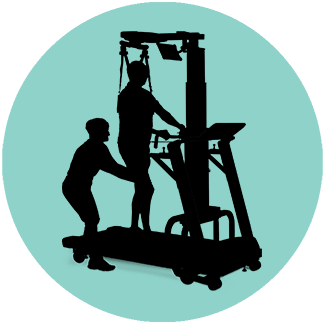 It’s different via zoom. I couldn’t scan the room with my eyes and see what was available – something I do automatically whenever I walk into a training session (knowing they had a massage table would have made things easier….) But we got set up and onto the treadmill and ready to start the motor… except “I’m feeling nauseated” he says as his wife remarks that he is VERY pale. Despite wearing support stockings and an abdominal binder it appears that his blood pressure has dropped, and I talk the family through lowering him back into the chair and loosening the harness for some breathing room, tilting him back and elevating legs and waiting for it to pass. In an in-person training session in a rehab facility that might be the end of the session. We only have 30 minutes with each patient. But it’s the weekend, and I am sitting on my couch, so we wait it out. He says he is feeling better and ready to get back to work. Back up into standing, and onto the treadmill, I talk them through body weight supported gait training techniques with one helper at each leg. The clonus on the right is not too bothersome, but man, is it a workout. We reach .6 mph and keep it going for a couple of minutes, rest and then another 5 minutes or so. Not too bad for a first session. Let’s pick this up again tomorrow, and we can tweak the setup. I provide a link to an instructional video for them to review – tomorrow we will adjust harness application since I know you have the massage table in advance…
Day 2 starts out differently. They log in with him harnessed up, and the room rearranged per my suggestions.  Lifting to stand and onto the treadmill is much faster, and BP holds steady. 2 different helpers today (gonna train the whole family so they can take turns), and I talk them through the gait training. Our target training speed is 2mph, and I figure it will take a couple of weeks to build up to that speed.
Nope, he reaches it on day 2, with 3 bouts of 5 minutes walking. BP holds steady, that clonus doesn’t rear it’s ugly head at all, and the assistance is easier to provide at the faster speed. “I feel my thighs” he says… pain? “no, tingling, or a little burning like I feel them working – like a workout. Both of them.” The right had no sensation when we got started – an unexpected outcome, to be sure. I thought it would take longer to get up to the speeds necessary to up-regulate the spinal locomotor mechanisms. More sessions of coaching before they were ready to fly on their own. They proved me wrong. I was afraid to let them go just yet. Asked them to record a few seconds of their next session and send it my way. Keep a log of training and response. And zoom me again mid-week, so I can be sure you are managing. But I am pretty sure they will continue to prove me wrong. I thought I was good at role-release pre-COVID. But COVID has taught me that my “magic hands” really aren’t all that magical at all. Families are plenty capable, even without me in the room with them.